
Building a High-Impact Command Centre on a Shoestring Budget
If you’ve spent any time on Pinterest lately, you’ve likely seen them: those $300 custom-etched acrylic “Command Centres” that look more like corporate boardrooms than a spot for muddy cleats. When you are managing the “beautiful, exhilarating chaos” of a large family or a busy sports season, those price tags can feel like just another hurdle in your “survival mode”.
But here is the secret from the “mum-squad”: you don’t need a designer budget to find your predictable rhythm. Instead of thinking of your command centre as an expensive control panel, think of it as a Family Anchor.
An anchor doesn’t need to be gold-plated to work; it just needs to be heavy, reliable, and visible enough to keep your ship from drifting into the rapids of “last-minute scrambles”. Here is how to build your anchor using low-cost, DIY tools.
1. The Power of Paper and Pen (The Zero-Cost Anchor)
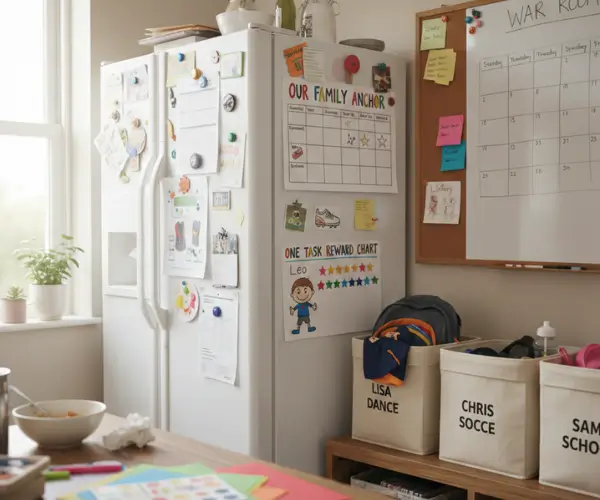
You don’t need a magnetic glass board to start. The simplest, most effective tool is often a “One Task Reward Chart”. This is a zero-cost DIY project: just a piece of paper, a pen, and maybe a few stickers.
For younger kids, you can create picture schedules using simple drawings—a plate for breakfast or a bed for sleep—to help them follow the day independently. Letting your children draw or colour their own icons for the schedule actually increases their “ownership” of the routine, which is half the battle.
2. Sticky Notes and “Everything Bags”
If you aren’t ready to commit to a permanent wall fixture, use sticky notes or small laminated checklists. These are portable “mini-anchors” that can move from the kitchen to the car.
Another essential low-cost hack is the “Everything Bag”. You don’t need to buy new bags; just designate an existing backpack for each sport. Packing it the night before with “everything”—uniform, socks, and water bottle—prevents the 7:00 AM “Mom, where is my…?” search.
3. Repurposing Your Space
Sarah, a mom of six, uses a giant whiteboard in the kitchen as her “war room”. If a large board isn’t in the budget, your refrigerator is a built-in magnetic surface! Use it to display your chore chart for kids, and use magnets or Velcro to move task cards around.
Don’t forget the “Designated Chaos Zones”. You can use a simple kitchen cabinet or cheap baskets in the living room to contain “stuff.” It’s not about perfect decor; it’s about containing the mess so the whole house doesn’t become a “disaster zone”.
4. Start Small, Ripple Big
The most important principle of a visual routine is consistency, not the price of the materials. Whether you use a high-tech app or a handwritten list on the fridge, the goal is to shift the “mental load” away from your voice and onto the tool. When the chart becomes the reminder, the “nagging” stops.
If you feel overwhelmed, “pick one thing”. Maybe it’s just a paper checklist for school bags by the door. These small, consistent changes create big ripples that turn daily chaos into a “well-oiled machine”. Remember, we aren’t just trying to have a clean house; we are raising “future adults” who know how to anchor themselves