
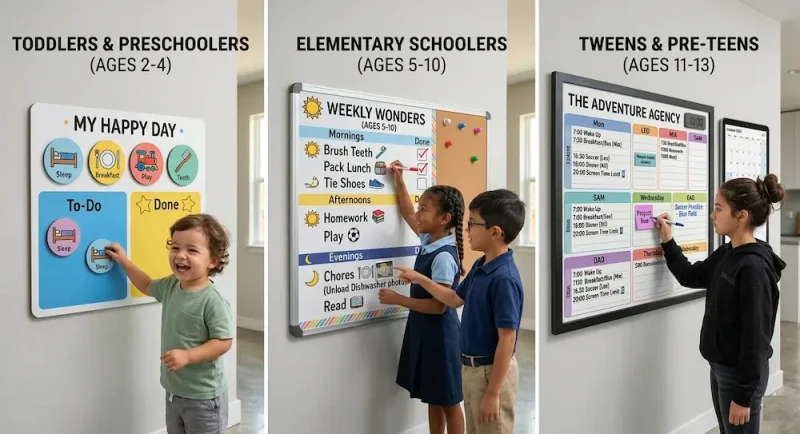
If you have kids of varying ages, you know that what works for a toddler is likely to be met with a massive eye-roll from a pre-teen. Parenting is a journey, not a destination, and our routine boards need to evolve alongside our children’s growing abilities. The goal of a routine board is to provide a visual representation of the day, typically divided into morning, afternoon, and evening sections. Here is how you can tailor that “Family Anchor” to suit every stage of childhood.
Toddlers and Preschoolers (Ages 2–4)
At this stage, children thrive on absolute predictability and simple, direct cues. Since they aren’t reading yet, picture schedules are your best friend. Use clear, high-contrast symbols like a bed for sleep, a plate for breakfast, or a brush for teeth.
The “Real Life” Relatability: Think of the “Bedtime Battle.” Instead of repeating “Put your pajamas on” ten times, a toddler can move a Velcro icon of pajamas from the “To-Do” side to the “Done” side.
- Pro Tip: Use actual photos of your child doing the task. Seeing a photo of themselves brushing their teeth creates a powerful “That’s me!” connection that boosts their confidence and cooperation. Focus their board on basic hygiene, naps, and “special time” with you.
Elementary Schoolers (Ages 5–10)
As children enter school, their routines need to support academic and social development. Their boards should become slightly more complex, including school prep like laying out clothes or packing backpacks the night before. This is the perfect time to transition from just pictures to a mix of words and images, which reinforces early literacy.
The “Real Life” Relatability: Consider the “Morning Scramble.” A 7-year-old might have a checklist item for “Check Weather/Pick Shoes.” This prevents the last-minute realization that they’ve picked canvas sneakers on a rainy day. You might even find they start their routine independently—a total parent dream!
- Family Contributions: This is also the ideal age to introduce chores. Use the board to show that “Screen Time” happens after the “Unload Dishwasher” icon is moved. It turns you from a “nagger” into a “manager” of the board’s rules.
Tweens and Pre-Teens (Ages 11–13)
By the time they hit the double digits, routines should focus on independence, self-regulation, and negotiation. While they still need clear expectations for bedtime and screen limits, these should be discussed together to fit their increasing social and school commitments.
The “Real Life” Relatability: The “Homework Hurdle” is real here. Their “board” might shift from a wall-mounted chart to a sleek desk planner or a shared digital checklist. For example, if they have soccer on Tuesdays, their routine board should reflect a “Quick Snack & Kit Prep” block immediately after school.
- The Shared Command Center: In a busy household, a giant color-coded whiteboard in the kitchen can serve as a “personalized flight control tower.” Older kids can see their specific tasks at a glance—like “Empty Rubbish” or “Walk Dog”—without a single word being exchanged. It respects their growing need for autonomy while keeping the household running smoothly.
Why the Evolution Matters
Updating these boards isn’t just about organization; it’s about metabolizing responsibility. When we give a toddler a picture, we are teaching them what to do. When we give a tween a planner, we are teaching them how to manage their life. By the time they reach high school, the routine board might disappear entirely, replaced by the internal habits you helped them build year after year.
The Routine Board Toolkit: Materials That Work
Building a routine board doesn’t require a degree in interior design, but choosing the right materials makes the system stick. Here is what you’ll need to bring these boards to life:
1. For the Little Ones (Ages 2–4): Tactile & Visual
- Self-Laminating Sheets: Essential for protecting picture cards from sticky fingers and spills.
- Velcro Coins (Hook and Loop): These are satisfying for toddlers to “click” into place when a task is done.
- Magnetic Tape: If you want to use the fridge as your command center, stick a strip of this to the back of your laminated photos.
- Large Poster Board or a Baking Tray: A cheap cookie sheet makes a fantastic, portable magnetic board!
2. For Elementary Schoolers (Ages 5–10): Interactive & Customizable
- Chalkboard or Whiteboard Markers: This age group loves to physically check things off.
- Clothespins: A simple “Clip System” works wonders—clip the task to the “To-Do” side of a ribbon and have the child move it to the “Done” side.
- Printable Icons: Look for “Daily Rhythm” digital downloads that include school-specific tasks like Pack Library Bag or Put Away Shoes.
- Washi Tape: Use colorful tape to create permanent “zones” on a whiteboard so the structure stays put even when the writing is wiped away.
3. For Tweens & Pre-Teens (Ages 11–13): Sleek & Professional
- Acrylic Wall Planner: These look “cool” and sophisticated rather than “babyish.” They blend into home decor while keeping schedules visible.
- Multi-Colored Liquid Chalk Pens: Assign a specific color to each family member. This makes the “Flight Control Tower” easy to read at a glance.
- Magnetic Cable Ties or Clips: For the older kids who are managing devices, having a dedicated spot on the board to “dock” their phone or tablet when screen time is over helps reduce friction.
- Shared Digital Calendar App: While not a physical supply, a QR code printed and tucked into the corner of the physical board can link them directly to the family’s digital schedule.
The “Keep It Simple” Rule
Don’t feel the need to buy everything at once. Start with what you have in the cupboard—even a piece of cardboard and some markers can start a life-changing habit today. The best board isn’t the prettiest one; it’s the one that your family actually uses.