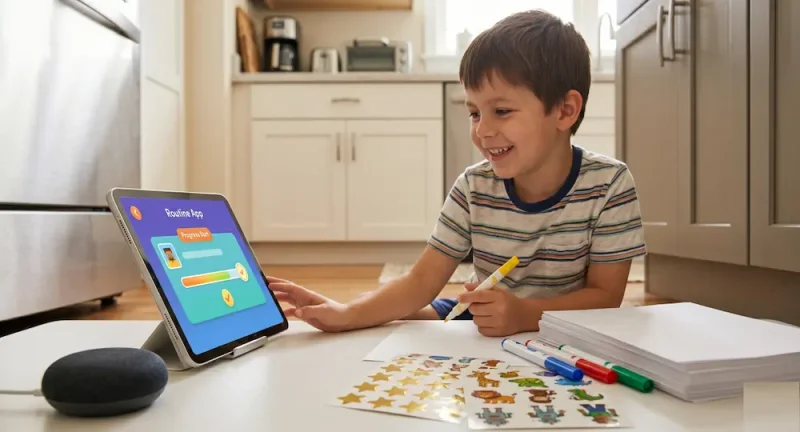
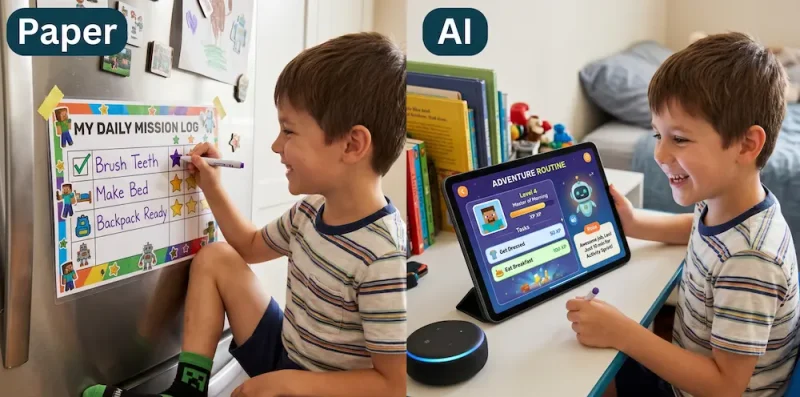
Choosing between a digital app and a physical paper chart is the modern parenting crossroads. For an 8-year-old, the best routine chart is the one they will actually use without you hovering. While AI offers high-tech engagement, paper provides a tactile “win” that builds real-world independence.
The Quick Win
- Paper is King for Focus: Best for tactile learners who get distracted by screens.
- AI is Great for Gamification: Best for kids who love “leveling up” and need audio reminders.
- The Hybrid Approach: Use a paper chart for the morning “to-do” and an AI timer for “Activity Sprints”.
The 8-Year-Old Brain: Development Meets Independence
At eight years old, your child is in the “Schooler” stage (ages 5–10). They are developing stronger “helping focus” skills and crave a sense of mastery over their own day. They are old enough to follow a sequence but still young enough to be lured away by a rogue Lego brick or a TV in the background.
The Case for Paper: The “Tactile Win”
There is something deeply satisfying about physically crossing an item off a list. For an 8-year-old, a paper chart acts as a “Screen-Sidekick” that doesn’t come with the temptation of YouTube.
Why Paper Works:
- Zero Distractions: No notifications, no “just one more video,” and no battery issues.
- Permanent Visual Cue: It lives on the fridge or the bedroom door, acting as a constant, silent reminder.
- Creative Ownership: Kids can decorate their chart with Minecraft stickers or drawings, making it their own “Inventory Check”.
The Case for AI: The “Digital Level-Up”
If your child is a tech-lover, a digital routine or an AI-guided assistant can feel less like a chore and more like a game.
Why AI Works:
- Automated Reminders: Instead of you being the “bad guy” who says it’s bedtime, the AI assistant handles the alert.
- Minecraft Hooks: You can frame the routine as “Leveling Up Your Morning” or completing a “Daily Quest”.
- Dynamic Feedback: Some AI tools can play a “Clean Up” song or a 10-minute “Activity Sprint” timer automatically.
Comparison: AI vs. Paper at a Glance
| Feature | Paper Charts | AI & Digital Tools |
| Setup Time | 5 mins (Print & Go) | 15-20 mins (App setup) |
| Cost | Pennies/Free | Often requires a subscription |
| Distraction Risk | Low | High (potential for screen-time drift) |
| Kid Appeal | Tactile/Satisfying | “Cool” factor/Gamified |
How to Choose (The “Holding a Toddler” Test)
Before you commit to a complex digital system, ask yourself the KRP Golden Rule: “Can I manage this while holding a crying toddler?”. If syncing an app feels like one more “to-do” on your plate, go with a minimalist paper template.
When to choose Paper:
- Your child is easily overstimulated by screens.
- You want to reduce your own tech use in the morning.
- You need a solution you can set up in under 3 clicks.
When to choose AI:
- Your child is highly motivated by “XP” and digital rewards.
- You are already using smart speakers for music or timers.
- Your 8-year-old is tech-savvy and handles “screen-sidekicks” responsibly.
The “Minecraft” Strategy: Using Passions to Power Routines
Regardless of the medium, use your child’s interests as the “hook”. For an 8-year-old Minecraft fan, a routine isn’t just a list of chores; it’s a mission:
- The Morning Ritual: “Inventory Check for School” (Backpack, lunch, water bottle).
- The Transition: “Moving to the End Portal” (Bedtime routine).
- The Reward: “Unlocking Creative Mode” (Free time after tasks are done).
The KRP Verdict
For most 8-year-olds, Paper wins for the Morning Success Ritual, while AI wins for the Bedtime Transition. Use a physical chart in the kitchen to keep them on task during the “morning chaos,” and use an AI-guided “Clean Up” song or yoga session to wind down at night.